
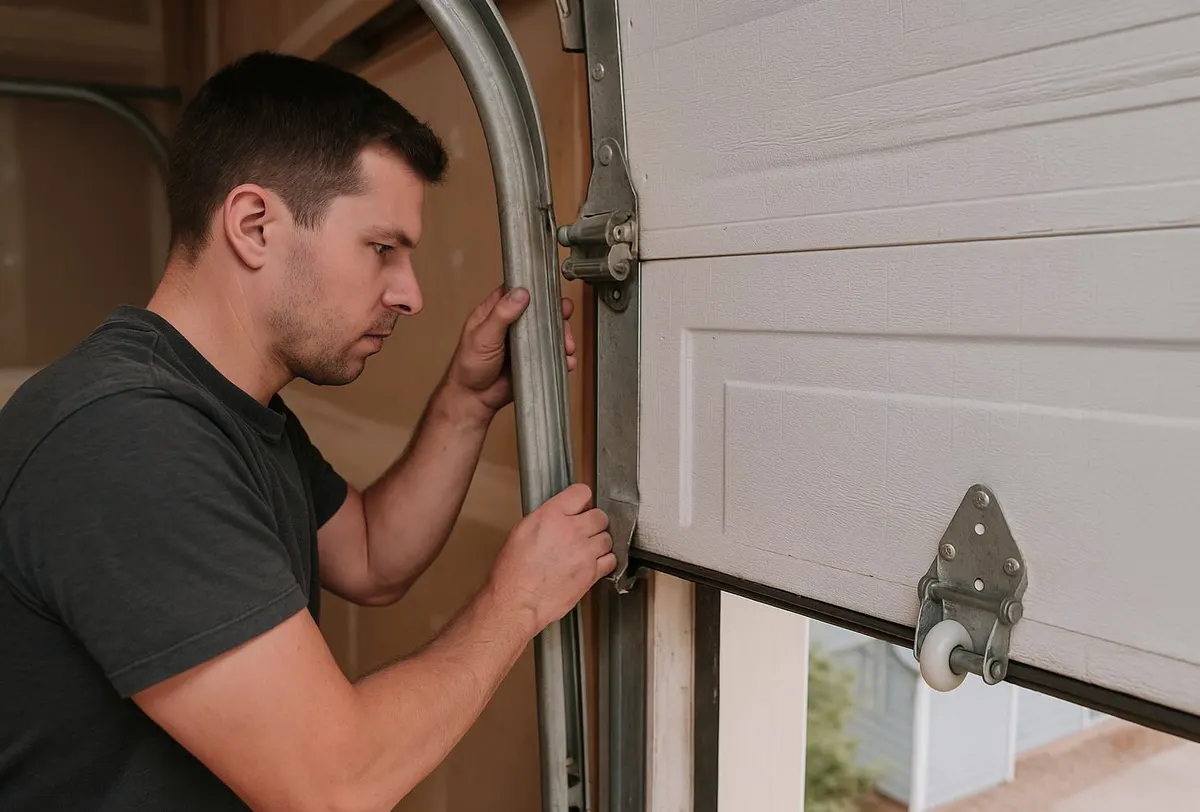
What a Service Call Looks Like After a Windy Night
After a hard blow off the lake, the calls follow a pattern. A homeowner wakes up to a garage door bowed outward in the middle, sometimes with a horizontal crack across a panel. Or the door is fine but one of the top rollers has popped out of its track because the wind flexed the whole door just enough to walk it loose. In the worst cases, the opener's drive rail has been yanked away from the header because the door tried to lift off its track mid-gust and the opener took the load it was never built to handle. Almost every one of these calls involves a door that looked completely normal the day before.
Why the Garage Door Is a Home's Weakest Wall
A standard garage door opening is the single largest unsupported gap in most houses — often 16 feet wide or more, covered by a panel system that's light by design so the opener can lift it. Every other wall on the house is braced by studs, sheathing, and a continuous structure tying it to the foundation and roof. The garage door is held in place mostly by its track, hinges, and the opener's drive mechanism, none of which are built to resist sustained wind pressure.
When wind gets behind a door that fails — through a crack, a gap at the bottom seal, or a full blowout — it pressurizes the garage like a balloon. That pressure pushes up on the roof decking from underneath, which is a common way roofs get torn off in straight-line wind events, independent of any direct wind damage to the roof itself. The door isn't just a door at that point; it's the pressure valve for the whole structure.
Why This Matters for Erie County Homes
Shoreline and open-field exposure in this part of Ohio means wind gusts can build with very little to slow them down before they hit a garage door head-on. Fall storm systems moving across the lake, combined with the same wind events that bring the spring severe weather season, put real lateral load on doors that were never rated for it. Add in homes with older doors — thinner steel, no internal bracing — and a storm that would just rattle windows elsewhere can be enough to buckle a panel here.
What to Check Before Storm Season Gets Serious
- Track and hardware: Look for loose bolts on the track brackets, bent track sections, or rollers that are worn and rattling. A track that's even slightly out of alignment gives wind more room to work the door loose.
- Weatherstripping and bottom seal: Gaps at the bottom or sides aren't just a draft problem — they're where wind pressure gets a foothold. Cracked or flattened seals should be replaced before late fall, not after the first big storm finds the weak spot.
- Panel condition: Hairline cracks, rust bubbles, or dents already compromise a panel's strength. Wind load finds existing damage first.
- Opener and manual release: Know where the manual release cord is and make sure it works. If the power goes out during a storm and the door is partially open, you need to be able to close it by hand.
- Reinforcement struts: Horizontal struts bolted across the back of each panel stiffen the door against bowing. Many standard residential doors don't come with them as standard equipment, especially older installations.
Reinforcement vs. Replacement
For a door that's structurally sound but lacks bracing, a reinforcement kit (horizontal struts, upgraded end hinges, reinforced track brackets) is the lower-cost route, generally in the low hundreds of dollars depending on door size and materials. For a door that's older, already damaged, or simply undersized for the openings it's spanning, a wind-rated replacement door is the better long-term call — these use heavier gauge steel and built-in bracing designed to handle higher pressure differentials, and they typically run from the low thousands into higher ranges depending on size, insulation, and材料. The trade-off is upfront cost versus the risk of a panel failure mid-storm, which almost always costs more to fix than the reinforcement would have.
When to Call Sandusky Door & Opener
If your door already shows bowing, loose track hardware, or worn seals, don't wait for the next system to roll in off the lake. Our Garage Door Maintenance service checks track alignment, hardware tightness, and seal condition before problems turn into storm damage. If your door is older or undersized for its opening, we can walk you through Garage Door Installation options built with wind resistance in mind, including bracing and heavier-gauge panels suited to this area's exposure.
Call Sandusky Door & Opener today to get your garage door storm-ready before the next round of lake wind moves through Sandusky, OH.